

One of the biggest benefits of choosing Google Workspace for your business is how user friendly it is. Many of your employees will already be familiar with the main Workspace apps, and they’re all designed to be intuitive for new users to learn.
That could lead you to think that training is unnecessary, but that’s a mistake.
Google Workspace training can take your team beyond the basics and ensure they know how to get the most out of the productivity suite’s features.
Why Google Workspace Training is Important
As with any technology, how useful Google Workspace is has everything to do with how you actually use it. Teaching your employees the full capabilities of all the Workspace features available to them can lead to higher productivity, improved security, and potentially introduce new use cases your team hadn’t previously considered.
For example, employees can probably figure out how to check their inbox in Gmail and reply to emails easily enough. But they may not realize they can also set up filters to pre-sort their emails, helping them automate inbox organization, more easily prioritize important communication, and save time.
Similarly, those knowledgeable about what’s possible in Google Drive can use macros in Sheets to set up complex automations, use the advanced collaboration features in Google Docs during the editing process, and use resource calendars in Google Calendar to better organize reservations for physical resources.
All of these features can simplify internal operations and make people’s lives easier, but only when you know how to use them. Plus, Google Workspace training can help you understand all the different Workspace apps available to you — some of which your team may not know about yet.
The list of products included in different Workspace plans is long, and each one has the potential to provide value to your team, as long as you have the knowledge to use them well. Some of the main Google Workspace applications you may want additional training to use include:
| Workspace Application | Description |
| Admin Console | A centralized management dashboard used by IT administrators to configure security settings, manage user accounts, and oversee device compliance across the organization. |
| Gemini in Workspace | An embedded AI assistant used across Workspace to help write content, summarize threads, build formulas, and analyze data directly within your apps (not to be confused with the other parts of the Gemini ecosystem). |
| Gmail | A secure email platform used for professional communication, message organization, and smart drafting. |
| Google Chat | A team messaging platform used for direct communication, group spaces, and quick project updates. |
| Google Calendar | An integrated scheduling tool used for managing time, planning meetings, and tracking shared team timelines. |
| Google Meet | A high-definition video conferencing platform used for virtual meetings, screen sharing, and team collaboration. |
| Google Drive | A secure cloud storage hub used for saving, organizing, and accessing files from any device. |
| Google Docs | A real-time, collaborative word processor used for creating, editing, and sharing text documents. |
| Google Sheets | A cloud-based spreadsheet application used for data analysis, complex calculations, and project tracking. |
| Google Slides | A presentation tool used for building visually engaging slide decks and pitching ideas collaboratively. |
| Google Forms | A survey and quiz builder used for collecting structured data and analyzing responses automatically. |
| Google Sites | A collaborative website creation tool used to easily build internal team portals, project landing pages, and public websites without needing to code. |
| Google Keep | A lightweight note-taking app used for capturing quick ideas, checklists, and voice reminders on the go. |
| Google Tasks | A personal to-do list manager used for tracking daily action items and setting deadlines across your inbox and calendar. |
| Google Vids | An AI-powered video editing and creation tool used for easily building workplace videos, storyboards, and presentations. |
| AppSheet | A no-code development platform used to build custom mobile and web applications directly from existing Workspace data sources like Google Sheets. |
| Google Voice | A cloud-based phone service used for making and receiving professional business calls, managing voicments, and routing text messages from any device. |
| Workspace Studio | An AI-driven automation platform used to connect Google apps and build customized multi-step workflows using conversational prompts. |
| NotebookLM | An AI-powered research assistant used to synthesize, summarize, and answer complex questions based entirely on your uploaded source documents and notes. |
| Google Vault | An information governance and eDiscovery tool used to retain, archive, search, and export an organization's Workspace data for legal and compliance needs. |
If you’re not well versed in everything on this list yet, then you have more to learn. Google Workspace training is how you get there.
Tips for Effective Google Workspace Training
Investing in Google Workspace training is clearly worthwhile, but it’s important to approach your training program the right way in order to get effective results. As a Google Workspace consulting firm with extensive experience, we can recommend a few valuable tips to make your training successful.
Leverage Online Resources
You don’t have to start from scratch. Google has published a large library of resources to help new users learn how to use all the Google Workspace apps and features. But dropping a lot of links on your team can be overwhelming, so consider taking time to review the resources yourself in order to make more specific recommendations.
The Google Workspace Learning Center is a good place to start. It offers a quick start guide, links to training pages divided by product type, and a “quick tips” library. For people new to Workspace, it’s a great collection of resources to learn the basics.
Workspace’s help center even provides tips on how to spend your first day and week using the product, along with industry-specific training resources to help your employees jump to the information most relevant to them.
You have every reason to take advantage of the training materials Google has already created for you, but you may also want to create some that are unique to your business and employee use cases.
Use the resources Google has created as a starting point, then build on them to create tutorials or articles based on how your team will use the products day to day. Adding a more personal touch to the resources you provide makes them more useful to your team.
The "Persona-Based" Training Strategy
While general purpose resources can be alright for learning the basics of how a product works, a "one size fits all" demo is unlikely to give your employees what they need. And worse, if people don’t feel like a demo is relevant to them, they’ll probably lose interest. If people spend a training session zoning out or scrolling social on their phone, it’s not a good use of anyone’s time.
To provide actually useful training that employees will pay attention to, it should be tailored to their specific jobs and needs. That starts by taking time to learn what typical day-to-day tasks look like in different roles.
Audit department workflows to better understand how each team is using the tools they have now. Then you can consider where various Workspace apps and features best fit into their jobs.
For example, your marketing team should learn how to use Shared Drives for storing key assets like your branding kit and style guide, and Google Docs’ collaborative features to work together on resources like blog posts and copy decks. Meanwhile, your finance team will benefit more from learning how to use Pivot Tables and set up BigQuery connections in Google Sheets.
Design your training around specific jobs each team needs to get done, instead of just showing employees how different features work. This step will work best if you team up with someone from within each department who can speak to some of the most common and important tasks the team regularly handles.
 Caption: An in-person Google Workspace with Gemini training delivered by Promevo's Principal Architect for Collaboration Cloud, Colin McCarthy.
Multi-Modal Learning for a Diverse Workforce
People have different learning styles and preferences. Trying to get every employee to consume information about Google Workspace in the same format will inevitably put some of them at a disadvantage.
The executive that thinks it’s good enough to issue everyone a 40-page PDF manual to learn from belongs in Office Space, rather than an actual, functional office.
Instead, you want to give workers a variety of options for learning the product. Think beyond articles and emails (although do use those), and consider creating:
- Short tutorial videos: 2-minute how-to videos can be good for learning individual features or applying them to particular use cases, and the short time investment makes them an easy sell for busy employees.
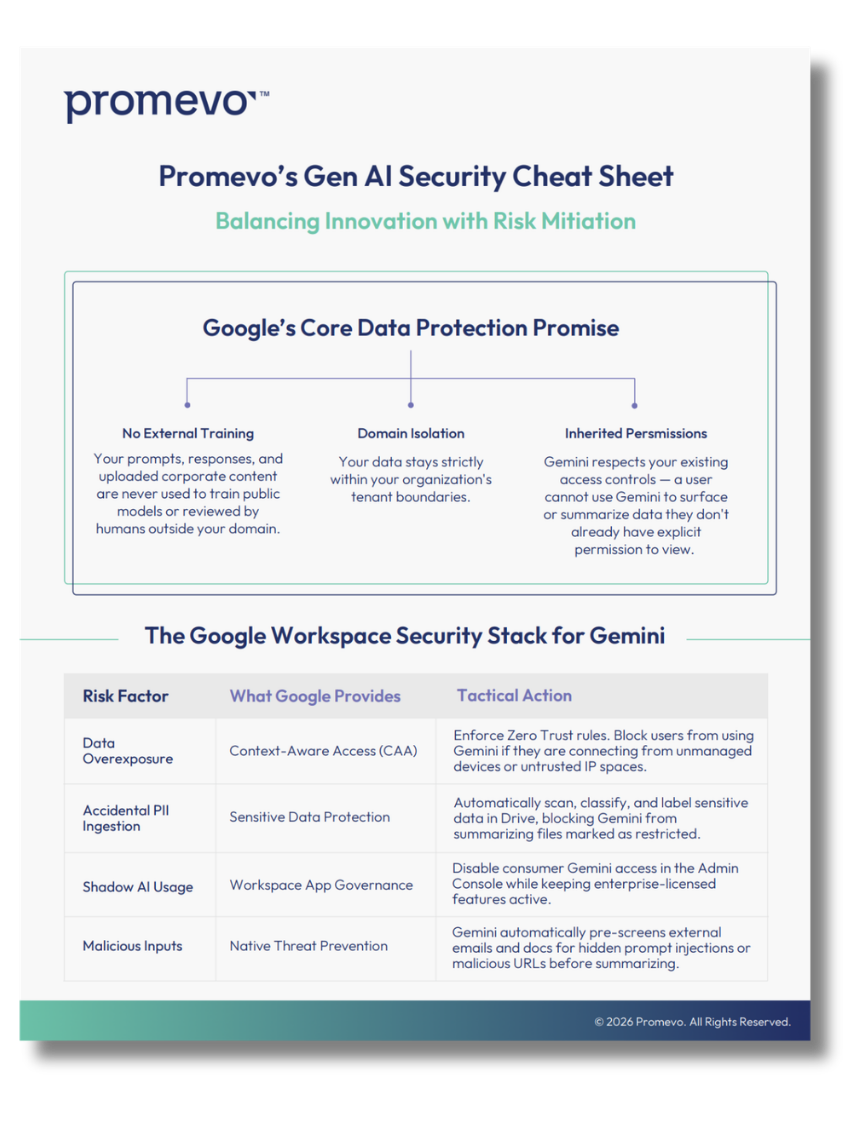
- Visual Aids: Interactive slide decks can combine text and visuals to help make sense of training tips, and "cheat sheets" that employees can save to their desktop or print out can serve as handy desk references when they need a reminder of how to take specific actions or access certain features.
- Hands-on Labs: Many people learn more effectively by doing something themselves than watching someone else do it. By hosting live "sandboxing" sessions where users can break things safely, you give employees a good way to learn the main Workspace skills they need to do their jobs. This works even better if you have an expert present who can respond to their questions in real time, or demonstrate skills in front of them for inspiration.
- Resource Hub: The training resources you create — across format types — need to be easy to find and access for people to benefit from them. Loading them all into a central hub that’s searchable and intuitive to navigate can mean more people actually read your articles, watch your tutorial videos, and download your visual aids. But don’t treat your Resource Hub as a static folder, it should be a living system. You want to continually update the Hub any time you create new resources to answer user questions or address new features Google releases.
Multi-modal resources you create let employees self-educate in the way they prefer. In addition, resources they can easily revisit any time they want help them keep their skills fresh and find answers when they need a reminder of how to do something.
Internal Champions
While having executive buy-in for your training program is crucial, it’s at least as important to recruit internal champions from within various departments. Peer-to-peer learning is often more effective than top-down instruction. People will often listen and respect the input of their everyday co-workers more than someone they don’t know as well.
Plus, working with departmental experts is necessary to gain insights into the main tasks and responsibilities each department faces. You need to understand the best ways to integrate Workspace apps into people’s day-to-day workflows in order to provide the most effective training.
Internal champions are also valuable for understanding what their colleagues are like and the concerns they’re most likely to bring up. They can help you consider and prepare for likely objections in advance, and develop strategies for how to appeal to each team member based on their needs and preferences.
Consider ways to reward or incentivize your internal champions for their help. You want them to feel invested in achieving successful onboarding for Google Workspace and valued for their extra work in making that happen.
Part of that could be in how you handle gamification (more on that in the next section), or you might consider offering something more straightforward like a promotion, a stipend, or an employee award.
Gamification
Change is hard, and some amount of resistance from employees is likely. You want to show employees you understand that learning a new product is a challenge and you appreciate their cooperation. One way to do that is with gamification.
Gamifying the training process gives employees incentives to take the actions you want them to. Start by considering the specific steps or actions you want them to take. That can include things like reading articles in the resource hub, watching training videos, or signing up for in-person training sessions. Establish goals based on these actions that you can encourage each employee to reach.
Then establish how you want to reward employees for reaching those goals. Some gamification strategies organizations deploy include:
- Awarding employees with digital badges based on the goals they achieve
- Setting up levels of achievement so employees can “level up” (e.g. they can go from beginner to intermediate to expert)
- Providing “Power User” certifications to employees that accomplish the most, to encourage friendly competition and self-paced learning
- Offering small rewards for meeting key goals (e.g. gift cards, extra PTO, free lunch)
Scaling Success with a Google Cloud Partner
Making an effort to get started right with a new technology can pay off for years to come. When people understand the full functionality and potential of a product as rich and versatile as Google Workspace, they can do so much more with it.
It’s worth getting your Google Workspace training right from the jump. And that’s a lot easier to pull off if you partner with Google Workspace experts who bring years of experience in Workspace training for your team to benefit from. Someone who knows Google Workspace inside and out will be equipped with all the knowledge necessary to teach new users how to get the most out of it.
Promevo is more than just a Google reseller, we’ve spent years helping organizations across industries learn how to reach the full potential of Google Workspace’s capabilities.
Our expertise extends from licensing advice, to ongoing account management, to training and workshops that help employees learn how to apply Google products to their jobs in the most effective ways possible. In addition to training, we also have experience guiding clients through migrations, security reviews, AI adoption, and more.
Google Workspace training just works better if you’re working with experts. Get started right with Promevo.