Hybrid work has changed how you and your teams plan, collaborate, and make decisions. As AI becomes a bigger part of that process, it’s no longer just about using AI but it's about choosing the right tool and case for usage.
The newest generation of large language models (LLMs) falls into two clear categories: instruct models and thinking models. The difference between them is more than technical. It defines how efficiently your AI supports everyday productivity, how much you spend on computation, and how well your organization innovates.
Google Cloud’s ROI of AI 2025 report found that companies pairing the right model to each workflow are seeing stronger productivity returns and faster innovation cycles. The right model mix helps you maximize both performance and value.
What Each Model Type Does
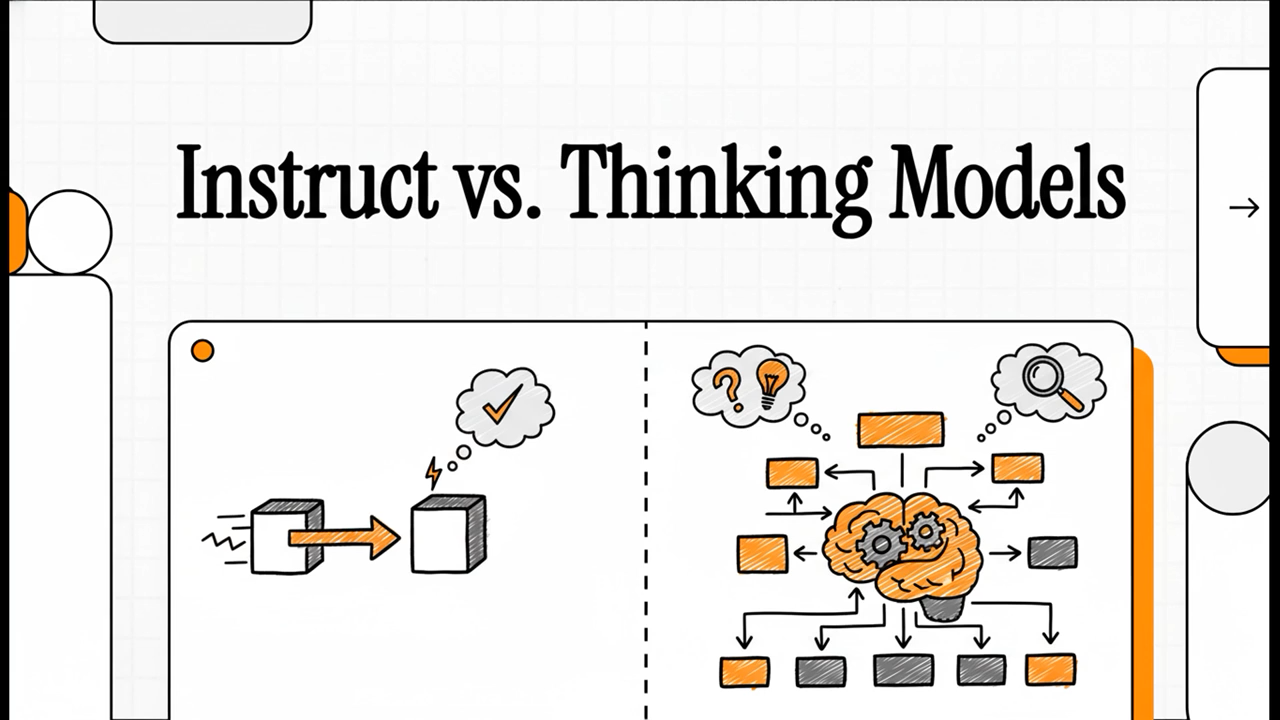
Instruct models are built for following clear directions. You tell them what you want, and they deliver a fast, accurate output. Examples include Gemini 2.0 Flash, GPT-4o, and Claude 3.5. These models excel at summarizing, rewriting, extracting information, or generating structured responses.
Thinking models take a reasoning-first approach. Rather than executing a single instruction, they plan, analyze, and reflect through multiple steps. Examples include Gemini 2.0 Flash Thinking, DeepSeek R1, and Anthropic’s O-series. They’re ideal for solving complex, unfamiliar, or multi-part problems that require logic and contextual awareness.
In simple terms, instruct models do, and thinking models reason. You choose between speed and depth depending on your goal.
Key Differences in Approach
Instruct Models
- Focus on efficiency, precision, and consistency
- Depend on clear prompts to guide responses
- Work best when the path from question to answer is straightforward
Thinking Models
- Break down tasks into smaller reasoning steps
- Evaluate options and test different logical paths
- Handle uncertainty and incomplete information more effectively
The choice comes down to how much autonomy you want the AI model to demonstrate. If your prompt already contains the full context, an instruct model is enough. If the task requires analysis, planning, or adaptive reasoning, a thinking model adds more value.
Performance Trade-Offs
Instruct models are fast, affordable, and scalable. Their lightweight architecture makes them ideal for daily AI-powered productivity tasks like drafting content, organizing data, or answering fact-based queries at scale.
Thinking models deliver more sophisticated results but require more time and computing power. Their reasoning processes increase cost and latency, which matters when you’re running high-volume workloads. They shine when accuracy, logic, and adaptability matter more than speed.
If you use a thinking model for a simple summarization task, you’ll pay more for a similar result. If you use an instruct model for complex reasoning, you risk incomplete or shallow answers. Matching the model’s strengths to the task is what drives ROI.
Common Use Cases
Instruct models fit best when you need:
- Content summaries or rewrites
- Marketing copy or campaign ideas
- Structured responses for FAQs or support chat
- Retrieval-augmented generation (RAG) using verified data sources
Thinking models make sense when you need:
- Multi-step reasoning or problem-solving
- Strategic planning across multiple variables
- Data or code analysis with dependency tracing
- Advanced agentic workflows that need autonomy
In most workplaces, both model types belong in your toolkit. The key is assigning the right one to the right type of work.
How to Choose the Right Model for Your Use Case
Start by identifying what kind of thinking your task requires.
- Task complexity: If it’s routine and clearly defined, use an instruct model. If it’s open-ended or involves uncertainty, choose a thinking model.
- Desired reasoning depth: Simple instructions call for execution; multi-step logic calls for analysis.
- Cost and performance balance: Instruct models scale efficiently; thinking models drive high-value insights but require more resources.
- Hybrid approach: Many organizations use both. Instruct models handle day-to-day requests, while thinking models address complex strategy, analytics, or innovation work.
You can also automate workflows that pass tasks between both types— an instruct model gathers and formats information, and a thinking model interprets it for decision-making. This layered approach often delivers the best ROI.
Even with a clear framework for choosing models, many organizations struggle with integrating them into existing workflows. AI is not just another tool to add; it interacts with people, processes, and data. Before assigning a model to a task, consider how it will interact with your team’s workflow.
For example, an instruct model can speed up reporting or automate repetitive data formatting, but its outputs are only as useful as the way they feed into decision-making. A thinking model can uncover insights that are not obvious from surface-level data, but it requires careful alignment with human review to ensure outputs are accurate and actionable.
A practical approach is to create workflow templates specific to each model type. Map tasks to the most suitable model and define checkpoints where humans review, validate, or refine outputs. This reduces wasted compute resources and ensures that AI complements human effort.
Over time, teams can experiment with hybrid strategies. Instruct models can gather and pre-process data while thinking models conduct multi-step analyses, allowing both speed and depth without overloading resources.
Finally, measure outcomes to refine your model allocation. Track metrics such as task completion time, error rates, and decision quality for each model type.
Treat AI as a measurable contributor to your processes. This approach helps avoid over-reliance on intuition and ensures that instruct or thinking models are deployed where they add the most value.
Structured monitoring and adjustment make AI adoption both efficient and strategically aligned, giving teams confidence that technology supports productivity and innovation.
Why This Distinction Matters Now
AI adoption is accelerating across remote and hybrid environments. Teams are integrating LLMs into planning, reporting, and creative work, but model choice still defines the results.
Google Cloud’s ROI of AI 2025 report found that early adopters of reasoning-capable systems. Reasoning-capable models are those that can plan, analyze, and adapt. Teams using AI reasoning for support are already seeing stronger productivity and faster innovation cycles.
Understanding how each model type fits into your workflows helps you spend smarter, automate more effectively, and build AI systems that align with your people’s needs.
Where Promevo Fits In
Your AI strategy should balance innovation with efficiency. Promevo helps your organization evaluate, test, and deploy the right model architecture for your goals.
You can rely on our team to:
- Identify where instruct and thinking models fit best across your use cases
- Help you deploy Gemini models securely within your Workspace environment
- Align your AI tools with clear productivity and ROI targets
When you choose Promevo as your partner, you gain a team focused on simplifying complex technology so your organization can scale intelligently and confidently.
Download Google Cloud’s ROI of AI 2025 report to see how leaders are optimizing their AI investments. Then, connect with us to map the right model mix for your business.

 Promevo

 Promevo : Apr 17, 2024