


In an era defined by the pressure to innovate and do more with less, employees are increasingly turning to generative AI.
And yes, AI wrote that sinker of a hook. That’s because everyone wants to boost productivity and creativity — not just employees, but contractors, vendors, interns, investors, C-level leaders, and consumers.
This need for speed has given rise to a robust "shadow AI economy."
A recent MIT study found that while only 40% of companies have official subscriptions to large language models (LLMs), employees at over 90% of companies are using personal AI tools for their daily work.
This unauthorized use of AI applications, known as Shadow AI, can expose your company to serious security, compliance, and operational threats. But the solution isn't to block progress by banning these tools — a move that often proves to be security theater. It's to channel this demand for innovation into a secure, sanctioned, and strategic framework.
This guide explores the risks of Shadow AI and outlines how to protect your organization by embracing enterprise-ready tools like Gemini in Google Workspace.
What Is Shadow AI?
Shadow AI is the unsanctioned use of any artificial intelligence tool or application by employees without the formal approval or oversight of the IT department.
Much like its predecessor, "shadow IT," where employees used unauthorized cloud services, Shadow AI arises when staff members independently adopt consumer-grade AI platforms like ChatGPT to automate tasks, edit text, or analyze data.
As the adoption of generative AI accelerates, the risks associated with this unmanaged usage are becoming a critical concern for business leaders.
The Hidden Risks of Unsanctioned AI
While employees may see these tools as harmless productivity boosters, unsanctioned AI poses several significant risks:
- Data Security & Privacy: When employees paste sensitive information into public AI tools, they can inadvertently expose the organization to data breaches and privacy concerns. According to one poll, one in five UK companies has experienced data leakage due to employees using generative AI.
- Compliance Concerns: For organizations in regulated industries, using non-compliant AI tools can lead to severe violations of standards like HIPAA or GDPR. Fines for major GDPR infringements, for instance, can cost a company up to €20 million or 4% of its worldwide annual revenue.
- Intellectual Property Exposure: Company intellectual property, such as code, marketing strategies, or product roadmaps, could be shared with third parties or used to train public AI models, leading to a permanent loss of competitive advantage.
- Inconsistent Quality & Accuracy: Outputs from consumer AI tools can be biased, inaccurate, or unverifiable. These hallucinations can lead to poor decision-making if not properly vetted.
- Reputational Risk: A leak of sensitive information or the misuse of inaccurate AI-generated content can cause significant damage to a company's reputation, undermining consumer trust.
Why Employees Turn to Shadow AI
To effectively manage Shadow AI, you first need to understand why employees use it. The primary drivers are often rooted in a desire for efficiency and a lack of official alternatives:
- Lack of Official Guidance: Without a clear policy or company-approved AI tools, employees are left to find their own solutions.
- Pressure to Improve Productivity: In a competitive landscape, employees are under constant pressure to increase their speed and output, making the promise of AI assistance highly attractive.
- Perception of Restrictive Tools: Employees might turn to unsanctioned technology when they find existing solutions insufficient or believe that approved options are too slow. Consumer-grade tools are often praised for their flexibility, ease of use, and immediate value.
From Risk to Reward: A Framework for Governing AI
Banning AI tools is an ineffective strategy that pushes usage deeper underground and further from security controls. The goal is not to eliminate AI but to enable its safe and responsible adoption. By implementing a clear strategy and deploying the right tools, you can transform the risks of Shadow AI into a competitive advantage.
1. Deploy Sanctioned, Enterprise-Ready AI Tools
The most effective way to combat Shadow AI is to provide a powerful, secure alternative. Gemini for Google Workspace is designed specifically for this purpose. Unlike standalone AI tools that create a fragmented IT environment , Gemini is woven directly into the Workspace applications your teams use every day, like Docs, Gmail, and Sheets. This seamless integration reduces friction and encourages adoption.
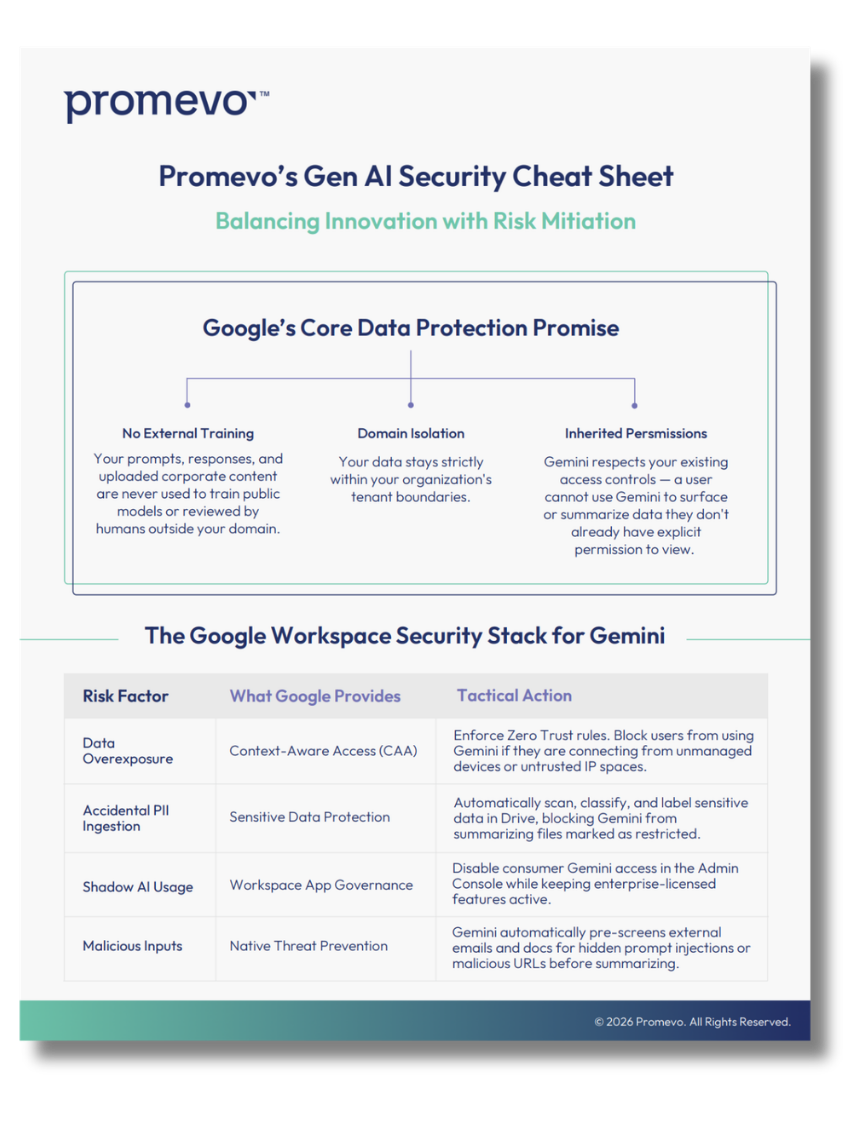
Critically, Gemini is built with Google's enterprise-grade security and privacy controls:
- Data Sovereignty: Your organization's data remains within your domain and is not used to train public models.
- Compliance: Gemini has achieved key certifications, like SOC 1/2/3 and ISO 27001, aligns with HIPAA, and has been submitted for FedRAMP High authorization.
- Centralized Controls: Gemini respects all existing Google Workspace security policies, including Data Loss Prevention (DLP) and admin-level controls.
2. Create a Clear AI Usage Policy
Work with IT, legal, and HR to establish a flexible governance framework. This policy should include clear guidelines on the types of AI systems that can be used, how sensitive information should be handled, and the training required for employees.
3. Educate and Enable Employees
Provide comprehensive training on both the risks of Shadow AI and the best practices for using sanctioned tools like Gemini. By enhancing awareness of the implications of using unauthorized AI tools, organizations can foster a culture of responsible AI usage. This educational effort shifts employee behavior from risky experimentation to productive, secure innovation.
4. Monitor, Audit, and Encourage Transparency
Because it may not be feasible to eliminate all instances of Shadow AI, organizations can implement network monitoring tools to track application usage and establish access controls. Fostering a culture where employees feel comfortable discussing their use of AI can help IT and security teams guide them toward safe, approved solutions.
Balance Security with Innovation
The rise of Shadow AI is a clear signal that your employees are ready to embrace the future of work. By channeling that enthusiasm toward a secure, integrated platform like Gemini, you can unlock massive productivity gains — Google’s research found users saved an average of 105 minutes per week — without compromising on security or compliance.
Don't let the risks of Shadow AI hold your organization back. Instead, view it as an opportunity to lead a structured, secure, and transformative AI adoption strategy.
Ready to move from Shadow AI to strategic AI? Promevo has helped hundreds of companies successfully implement and adopt AI through our Gemini for Google Workspace Deployment Workshops. For those looking to build powerful, custom AI agents, we also offer the Gemini Enterprise Pilot Workshop.
Contact us today to learn how to deploy AI safely and effectively across your organization.