



Everywhere you turn, businesses are rushing to incorporate generative AI and agentic AI to enhance productivity and streamline internal processes. For how transformative these tools can be, many businesses are skipping one crucial step: AI data readiness.
Companies have been learning the hard way that adding AI to your tech stack alone isn’t enough to get results. Last year, MIT reported that 95% of AI initiatives had failed to deliver the expected results. And in a study from Rand, data issues were the second-most common reason people gave for why AI projects failed (behind leadership failures).
It turns out that how you introduce AI into your business matters. Getting your data right is an important ingredient in the process.
At a Glance
- Up to 95% of corporate AI initiatives fail to deliver expected results, with data quality and readiness issues being one of the most common causes of project failure.
- Because AI systems rely entirely on your proprietary data, issues like fragmented silos, inconsistent formatting, incomplete records, inaccuracies, and data biases will inevitably lead to flawed AI outputs.
- To achieve AI data readiness, organizations must conduct internal audits, leverage expert assessments, choose integration-friendly tools, thoroughly clean existing datasets, and build a long-term data governance plan.
- Maintaining AI readiness requires establishing clear data ownership, training employees on data standards, and prioritizing security and compliance.
Data Quality and AI: "Garbage In, Garbage Out"
AI outputs have to be based on something. For business use cases, that typically means your proprietary data. Your AI tools and agents will only be capable of performing analysis, drawing conclusions, making recommendations, and taking actions based on the information you provide. If the inputs are flawed, the outputs will be as well.
Enterprise data issues can come in a number of different forms, some of the more common ones include:
- Data Silos: Enterprise companies usually have many different systems for different business functions, each that collect and store business data. If all those systems are disconnected from each other, the data AI tools can access will be fragmented. If your AI agents can’t see the full picture of your data, they’ll make decisions based on only a partial view.
- Unstructured or Unformatted Data: Over the years, different departments have probably all worked out their own systems for logging data in the main platforms they use. In many organizations, that creates data that’s inconsistent in how it’s formatted and structured across all those different platforms, making it even harder for AI tools to understand the data in a larger context and use it effectively.
- Incomplete Data: If AI can only access a portion of your data — whether because some is locked away in silos, some wasn’t saved or recorded properly, or some is formatted incorrectly — it will necessarily make recommendations and decisions based on limited information. That can lead to AI missing key trends and insights, and potentially drawing the wrong conclusions.
- Inaccurate Data: Manual data entry inevitably leads to some amount of human error due to typos, information left out, or a misinterpretation of the data. Then there’s all the data that was accurate at the time it was entered, but that’s become outdated since — customers that have cancelled, vendors that are no longer in business, addresses that have changed, etc. If your organization doesn’t regularly update and clean your data, a certain portion of it will be outdated.
- Biased Data: Generative AI will repeat the biases of the data it's trained on. You want to be aware of any potential biases baked into the data you have, so you can try to correct for it. This can be especially important when it comes to deploying AI for things like human resources, where an AI tool could inadvertently lead you toward issues like racial or gender disparities in hiring practices.
5 Strategies for AI-Ready Data
If learning about AI data readiness has you realizing how much work you need to do, you’re not alone. The need to develop a strong data governance strategy for AI is relatively new, but by taking the time now to do it right, you can set yourself up for much greater success in the years to come.
Strategy 1: Internal Audits
You have to fully understand your data situation now before you can make an effective strategy for moving forward. An internal audit will help you:
- Understand Your Current Data Quality: You need a snapshot of what your data looks like to start, so you can see how widespread any data quality issues are and what they look like. An audit will help you determine how much work you’ll likely need to do to get your current data cleaned up.
- Clarify Your Main Data Sources: The larger your organization, the more complex your data landscape is likely to be. You want to identify every platform, database, or other tool that currently contains important data you want your AI tools to have access to.
- Identify Any Process Issues: A lot of data issues have to do with the tools you use, but some have to do with how people use them. You want to understand how different teams and departments are handling data management now, so you can figure out what changes are required to create a more holistic data approach across the company. Look for bottlenecks in your current processes and discrepancies in how different teams are approaching data today.
- Understand Connectivity Issues: One of the biggest steps to achieving AI data readiness is figuring out how to make all your data broadly accessible across your tech stack, rather than locked away in individual products. An audit will help you identify which silos exist, so you can determine a plan to break them down and connect all your relevant products.
Strategy 2: Expert Reviews
Trying to get a clear picture of how your current structures and processes need to evolve to become AI ready is difficult. Bringing in outside experts who have worked on this kind of project before can be instrumental in helping you see the situation with clearer eyes.
A partner with experience in AI implementation, data governance for AI, and cloud health and security won’t just help you with one part of the process, they can help you see the bigger picture and develop a stronger plan for getting everything you need into place to truly succeed with AI.
Promevo helps clients with Workspace Security Reviews and Google Cloud Health Check Reviews so you can move forward with confidence that you have a strong, secure technological foundation to build your larger data governance strategy and AI initiatives on.
Strategy 3: Choose the Right Tools
Getting your data ready for AI can potentially be a big project, but investing in the right technological tools can make many parts of the process easier. When considering which tools will be the most valuable for your needs, consider:
- Integrations and Connectivity: A key part of AI data readiness is figuring out how to make your data accessible to AI tools across your whole tech stack. Look into products that will help improve the connectivity across your systems, so you can break your data out of existing silos.
- Specialized Functionality: A good AI strategy doesn’t try to force AI into everything. It focuses on identifying the specific use cases where AI can make the biggest difference, then tailoring your approach to match the need. An MIT study found that organizations that purchase AI tools from specialized vendors and build partnerships succeed around 67% of the time, while those who try internal builds succeed about a third as often. Identifying your specific needs and working with experts to implement the right tool for the job is the sweet spot for AI success.
- Automation Options: Trying to clean up all your data manually is a daunting task, and one that risks introducing new human errors into your data set. Instead, looking for software that will automate at least some parts of the process of deduping, re-formatting, and correcting data errors can be much more efficient. Plus, technology can help you stay on top of keeping your data clean by helping you create automated workflows that simplify the process moving forward.
- Visibility and Usability: Data management can be complex, especially when a lot of different systems are involved. You want to consider which products will help improve your visibility into your data across platforms, to help you better spot trends and potential issues. And ideally, you want the products you choose to be usable for everyone who needs access to your data or AI tools, not just your engineers.
Organizations that purchase AI tools from specialized vendors and build partnerships succeed around 67% of the time, while those who try internal builds succeed about a third as often.
Strategy 4: Clean Your Data
With a clear data strategy in place and the right software tools to help, the next step is tackling the project of cleaning your data. You want to re-start with a clean slate, at least to the degree possible. That means deduping your files, removing and correcting all errors, getting your data organized into the right structure and tools for use, and establishing a consistent system for formatting and tagging everything.
This may be a big project that takes some time. Use software to automate as many aspects of it as you can, to lighten the load of the humans tasked with reviewing and doing the rest. It may seem tedious and time consuming, but it will get you started on the right foot with your AI initiatives. And once you’ve established clear processes and formatting guidelines, it will be easier to keep your data in the right state moving forward.
Strategy 5: Establish a Clear Data Governance Strategy
Getting your data AI ready can involve a big one-time project, but you can’t treat it as done once the initial project is complete. It’s crucial that you establish a long-term data governance strategy to keep your data useful for AI projects in the months and years to come.
To develop a strong data governance strategy:
- Align Data to Use Cases: Having a big overarching strategy is good, but when it comes to putting the data to use, you want to hone in on specific use cases and projects. When you know what specifically you’ll be using your data for, you can clarify what data you’ll need and how best to make it accessible to your AI model or agent.
- Consider Security and Compliance: The potential downside of making your data more accessible to AI is that you could risk creating vulnerabilities in the processm if you’re not careful. Make sure every software tool you choose is designed with security and compliance top of mind, and factor security into every decision you make when incorporating AI further into your organization.
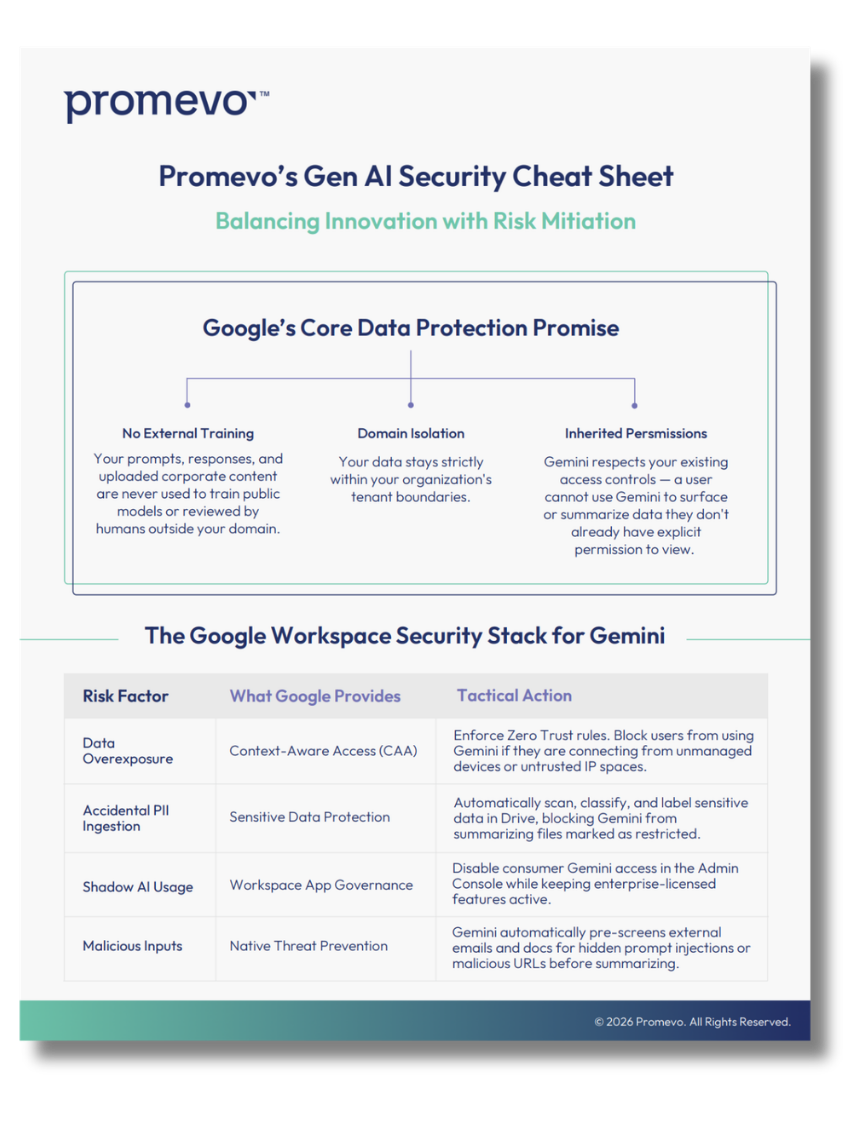
- Enforce Google Workspace Governance at Scale: AI assistants like Gemini Enterprise inherit whatever permissions exist in your environment. If your Google Workspace domain is filled with stale permissions, unmanaged files, or overshared Drive links, AI tools can surface sensitive information to the wrong users. Using a governance platform like gPanel® by Promevo acts as an enforcement engine. It translates governance policies into automated workflows, ensuring least-privilege access, eliminating orphaned user accounts, and fixing overshared files before your AI agents find them.
- Clarify Data Ownership and Responsibilities: While tools have an important role to play in AI transformation, people can make or break your AI initiatives. Make sure your strategy clarifies who’s in charge of handling each data management task, both during the initial AI-data readiness project and on an ongoing basis after.
- Use Automation and AI Agents: Look for opportunities to use automation tools and AI agents to handle as much of the initial data cleanup and ongoing data management as possible.
- Provide Training: While technology can take some of the work off your employees’ plates, they still need proper training in how to handle the rest. Provide your teams with instructional sessions on how to record, format, and tag all new data correctly so you can maintain proper formatting moving forward.
- Create Clear Guidelines and Resources: Training shouldn’t be a one-time occasion either. Create resources that clarify all data guidelines and processes to follow so employees have clear instructions they can reference. Make sure the information is easily accessible to all employees in relevant roles, and let them know who to contact any time they have questions or face issues.
AI Data Readiness Within Reach
Every AI initiative you launch must be built on a solid data foundation if you want to get real results. Building that foundation is easier with expert help.
For companies that use Google Workspace, achieving true AI readiness requires pairing proper administrative control with the right AI architecture. Promevo offers a complete ecosystem to guide you through this transformation:
-
gPanel: Provides the automation, visibility, and access control needed to govern your Google Workspace environment and clean up data exposure risks.
-
Gemini Enterprise Accelerator: Helps you plan, design, and launch agentic workflows and AI initiatives built on top of your governed data.
AI works better when you pair it with a clear plan and a secure foundation. Whether you need to audit your Workspace permissions or deploy advanced Gemini AI agents, Promevo can help you get more value from your AI investment safely.