

Work today doesn’t sit in one place, and it doesn’t always move in clean, predictable steps. Teams operate across tools, time zones, and priorities. Digital transformation helped you move faster, but it also created a new kind of overhead — constant coordination, endless handoffs, and too much “work about work” (something 60% of the average employee’s time at work is spent on).
Agentic work transformation changes that equation.
Instead of asking people to manage every step, you start building systems that can take action on your behalf. You move from tools that assist to systems that execute. That shift opens the door to a more scalable, more focused way of working — one where your team spends less time pushing tasks forward and more time shaping outcomes.
From Generative to Agentic: What Actually Changes
Generative AI gives you speed. You can draft content, summarize documents, and analyze data in seconds. That matters, but it still depends on you to prompt, review, and move the work forward.
Agentic AI takes the next step with you or better yet, for you.
You define a goal, set parameters, and give it access to the right systems. From there, it can:
- Pull data from multiple sources
- Make decisions based on context
- Trigger follow-up actions
- Loop through multi-step workflows without constant input
You can stop thinking in terms of isolated tasks and start thinking in terms of outcomes that run on their own.
Agentic work transformation builds on that capability. It reshapes how your organization operates by embedding these agents into the flow of everyday work.
The Three Pillars of Agentic Work Transformation
You don’t get value from agentic AI by turning it on and hoping for the best. You need alignment across how your team thinks, how your systems connect, and how your workflows run.
The Agentic Mindset
You need a shift in how you view work itself.
Your team has spent years operating under the assumption that people must oversee every step. That mindset creates friction as soon as you introduce agents. If no one trusts the system to act, nothing moves forward.
You start by redefining ownership:
- You focus people on direction, not execution
- You trust systems to handle structured, repeatable work
- You measure success by outcomes, not activity
That shift doesn’t remove humans from the process. It raises the level at which they operate. Strategy, creativity, and decision-making become the priority. Execution becomes a shared responsibility between people and systems.
The Agentic Architecture
Mindset alone won’t carry you far. You need infrastructure that supports autonomous action.
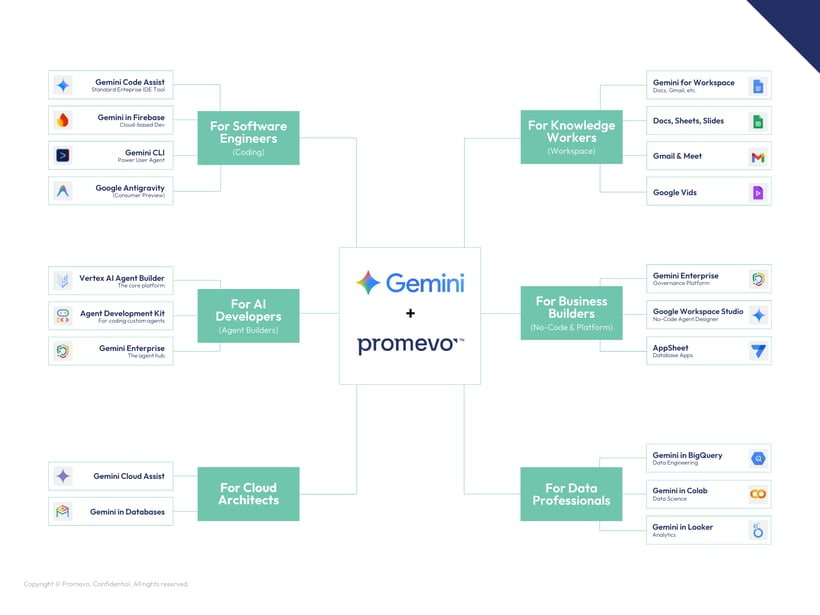
Within the Google ecosystem, that foundation comes together through the Gemini AI ecosystem (see depiction below). Each piece plays a specific role:
- Gemini Enterprise Agent Platform enables you to build and manage intelligent agents
- Gemini Enterprise provides the reasoning layer that understands context and intent
- Google Cloud connects your data, applications, and services
With the Google AI suite of tools, you can create an environment where agents can access the right information, interpret it correctly, and act within defined boundaries.
That architecture removes silos. Data no longer sits locked inside individual tools. Agents move across systems, pulling insights from one place and applying them in another.
The Agentic Workflow
This is where transformation becomes tangible.
You take a process that currently requires multiple people, steps, and approvals. Then you redesign it as an agent-led loop.
Instead of having to automate one task at a time, you can rethink the entire sequence:
- What triggers the workflow
- What decisions need to happen
- What actions follow those decisions
- Where human input still adds value
You end up with a system that can run continuously, escalate when needed, and improve over time.
That’s the difference between automation and transformation. Automation speeds up tasks. Agentic workflows reshape how work gets done.
How Gemini Connects the Work You Already Do
You already rely on Google Workspace to run your day. Docs, Sheets, Drive, Gmail —each tool holds part of the picture. The challenge has always been moving between them.
Gemini Enterprise changes how those pieces interact.
Instead of switching contexts, you create a layer that understands the relationships between your data and your actions. Gemini can:
- Pull insights from a Sheet and draft a report in Docs
- Summarize a thread in Gmail and generate next steps
- Extract data from Drive and update records in real time
But it doesn’t just connect with Workspace. It can also integrate with third-party software such as SharePoint, ServiceNow, and Salesforce.
No longer beholden to a bunch of individual apps, you can frame up a more connected system.
That connectivity makes agentic workflows possible inside the tools your team already uses. You don’t force adoption of something entirely new. You extend the value of what you already have.
Real-World Use Cases That Show the Shift
You don’t need abstract theory to understand the impact. You can see it in how everyday processes change.
Customer Success
Support teams spend a large portion of their time triaging tickets, drafting responses, and updating systems. That work follows predictable patterns, but it still requires constant attention.
With agentic workflows in place, you can:
- Monitor incoming tickets and categorize them automatically
- Draft personalized responses based on past interactions
- Update CRM records without manual entry
- Flag complex issues for human review
Your team stays focused on high-impact conversations instead of repetitive tasks.
Operations
Operational teams deal with constant signals— inventory levels, supply chain updates, internal requests. Each signal triggers a series of actions that often span multiple systems.
Agentic workflows can:
- Track inventory thresholds in real time
- Draft purchase orders as soon as levels drop
- Route approvals through chat or email
- Update records across systems once decisions are made
You reduce delays and remove the need for manual coordination.
Why This Shift Matters Right Now
You already see the pressure points:
- Too many tools that don’t talk to each other
- Too much time spent coordinating instead of executing
- Too many processes that depend on individual effort
Agentic work transformation addresses those issues directly.
You reduce “work about work” by removing unnecessary handoffs. You eliminate bottlenecks by allowing systems to act without waiting for input. You create space for your team to focus on strategic initiatives instead of administrative overhead.
This shift also changes how you scale. Growth no longer depends on adding more people to manage the same processes. You expand capacity by improving how work flows through your organization.
Where Most Organizations Get Stuck
You don’t struggle because the technology isn’t available. The path forward isn’t obvious until you carve one.
There are common AI deployment challenges you may face along the way:
- You experiment with AI but don’t move beyond pilots
- You lack a clear roadmap for integration
- You run into governance concerns around data and access
- You can’t align stakeholders on what success looks like
These obstacles can slow progress and create hesitation.
You need a structured approach that moves you from experimentation to execution.
How Promevo Helps You Move Forward
Agentic work transformation doesn’t happen through a single deployment. You need a roadmap that connects strategy, technology, and execution.
Promevo helps you build that roadmap through our Agentic Work Transformation Accelerator. In this multi-phase program, we help businesses like yours move through a clear progression:
- Define high-impact use cases aligned with your business goals
- Design workflows that support agent-led execution
- Implement the right architecture across Google Cloud and Gemini Enterprise
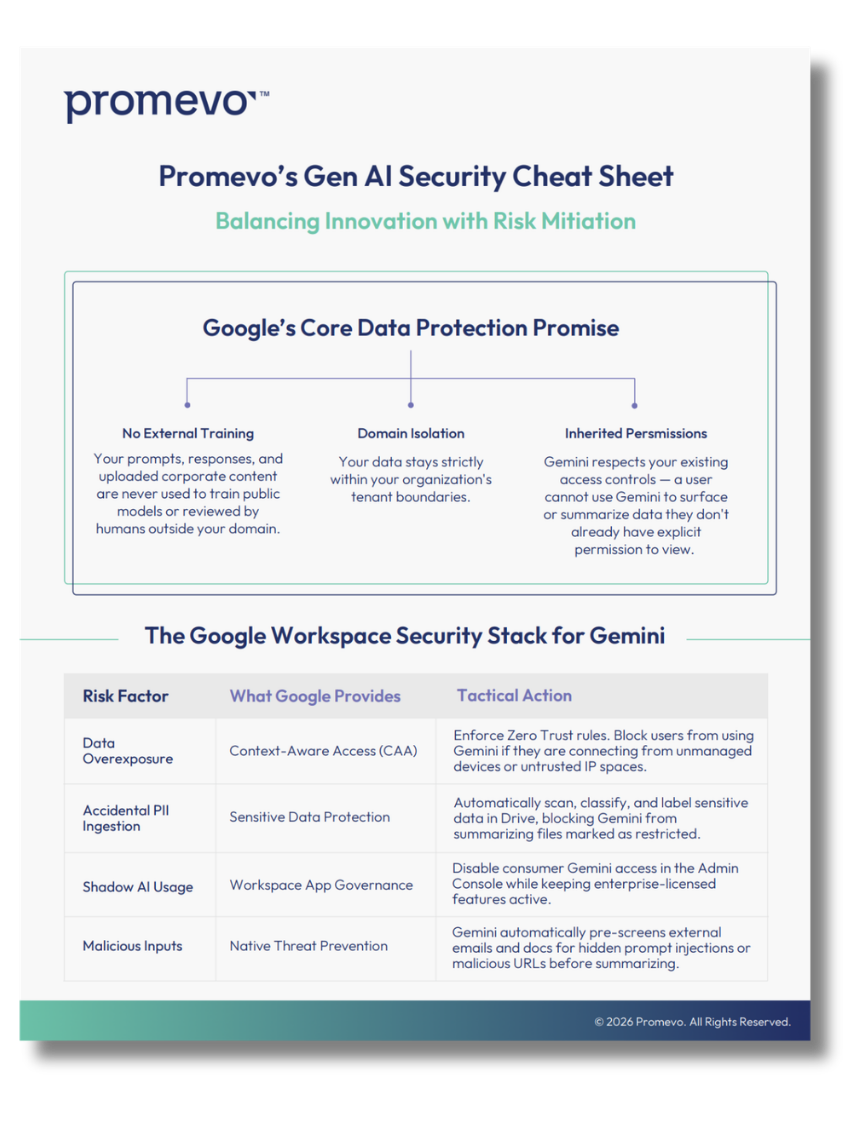
- Establish governance that keeps your data secure and compliant
- Scale successful workflows across your organization
You move from AI-curious to fully orchestrated, AI-powered environment.
Where gPanel Fits
As your environment becomes more connected, governance becomes more important.
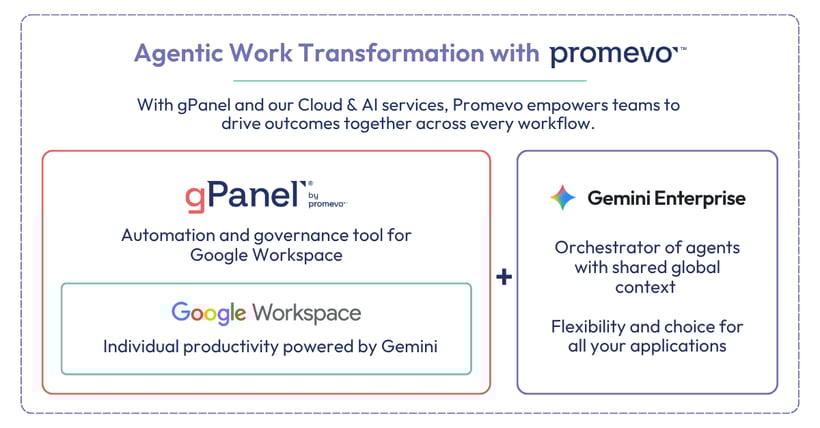
gPanel is our Google Workspace management platform that gives you deeper visibility and control across Google Workspace. You can:
- Manage user access and permissions at scale
- Monitor activity across your environment
- Enforce policies that protect your data
That control supports your agentic strategy. You gain the confidence to expand usage without losing oversight.
The Next Step
You don’t need to transform everything at once. You need to start with the right entry point.
Look at your current workflows. Identify where work slows down, where tasks repeat, and where coordination takes more effort than it should. Those areas offer the clearest opportunities for agentic transformation.
From there, you build momentum.
Promevo can help you map that path, implement the right solutions, and scale what works. If you’re ready to move beyond experimentation and start building a more autonomous, more efficient way of working, then let’s get started.