

Artificial intelligence has rapidly transitioned from an experimental initiative to a foundational operational requirement. Across enterprise environments, IT directors and engineering leaders rely on generative AI to automate routine workflows, accelerate software development cycles, extract insights from complex data repositories, and elevate user experiences.
However, the sheer volume of choices across the AI ecosystem has created an operational challenge: model proliferation. When evaluating platforms like Google Gemini, ChatGPT, or Claude, tech leaders are no longer selecting a single platform. They are selecting across multiple model tiers within each ecosystem — each tuned for vastly different performance parameters, computational latencies, and token costs.
This abundance often leads to decision paralysis or costly over-provisioning. IT teams frequently assume that the newest or most advanced reasoning model should be the default choice for every task. In practice, relying on an elite logic engine to execute basic text processing is the enterprise equivalent of using a race car for a routine grocery run—the task gets completed, but you pay a premium for capabilities you never actually touch.
wThe most effective enterprise AI strategy is not about finding a single "best" model. It is about building an intentional, multi-tiered architecture that pairs specific business objectives with the precise model tier engineered to solve them.
Evaluating Enterprise AI Workloads: Beyond Simple Benchmarks
Before choosing specific model tiers, IT leaders must evaluate the technical and operational demands of the underlying business tasks. Rather than defaulting to headline performance metrics, effective workload evaluation centers on three critical operational factors:
1. Latency and User Experience Expectations
In production environments, response latency directly dictates user adoption and operational feasibility. High-frequency, user-facing applications — such as real-time customer support agents, internal search tools, and interactive workflow assistants — require response times measured in milliseconds. Even minor delays disrupt operational flow, frustrate end users, and degrade the overall user experience.
For high-speed, high-throughput workloads, lighter models designed specifically for rapid output execution provide the optimal balance. By minimizing time-to-first-token and maintaining high throughput, these models keep real-time systems responsive without sacrificing output quality.
2. Operational Cost at Scale
While small pilot programs keep API consumption and operational expenses modest, the financial picture changes dramatically once AI capabilities integrate into daily enterprise operations. Enterprise workloads routinely involve millions of interactions, automated document processing across entire repositories, and agentic architectures that issue dozens of automated sub-queries per end-user task.
As usage expands, token consumption scales rapidly. A top-tier model that yields marginal performance improvements on routine tasks rarely justifies an exponentially higher operational cost. Sustainable enterprise deployment requires balancing model capabilities against input and output token pricing to prevent operational budgets from exploding as adoption grows.
3. Reasoning Depth and Task Complexity
Matching model intelligence to actual task complexity allows organizations to maximize output quality while maintaining strict cost controls. Routine operational tasks—such as reformatting copy, categorizing support tickets, summarizing meeting notes, or extracting specific fields from structured forms—demand consistency and speed, not deep logical reasoning.
Conversely, high-complexity tasks demand deliberate, multi-step problem-solving. Workloads involving complex system design, advanced refactoring, financial modeling, or scientific research synthesis require models engineered specifically for deep analysis and extended logical processing. Recognizing where a task falls along this complexity spectrum prevents teams from under-provisioning critical tasks or over-provisioning routine ones.
Google’s Gemini Ecosystem: Purpose-Built Tiers for Every Surface
Google’s Gemini model family is engineered around distinct performance profiles. Importantly, these model tiers do not just exist as backend developer APIs on the Gemini Enterprise Agent Platform—they also power Google's user-facing applications, including the Gemini app (gemini.google.com), Gemini for Google Workspace, and Gemini Enterprise. Understanding how these underlying tiers operate helps organizations make smarter architectural and licensing decisions.
|
Gemini Model Tier |
Core Operational Profile |
Key Strengths & Features |
Primary Enterprise Use Cases |
|
Gemini 3.5 Flash-Lite |
Ultra-low latency & high token throughput |
|
High-volume document processing, real-time agentic search, lightweight subagent orchestration |
|
Gemini 3.6 Flash |
High-efficiency operational workhorse |
|
Production AI agents, full-stack code refactoring, rapid software iteration, multimodal analysis |
|
Gemini 3.1 Pro |
Advanced analytical & context flagship |
|
Complex data synthesis, large-scale document repository analysis, multi-source research |
|
Gemini 3.6 Thinking |
Specialized deep logic & deliberate reasoning |
|
Technical protocol analysis, complex system architecture design, multi-step engineering challenges |
Gemini 3.5 Flash-Lite: Scalable Throughput for High-Volume Systems
When throughput and speed are the top operational priorities, Gemini 3.5 Flash-Lite serves as the ultra-fast workhorse. Processing up to 350 output tokens per second, Flash-Lite is specifically built for low-latency tasks and high-volume pipeline execution where rapid responses are paramount. It powers background execution in high-throughput enterprise systems and provides quick responses for consumer search tools, allowing organizations to scale agentic search and automated document processing economically.
Gemini 3.6 Flash: The Operational Workhorse for Modern Agents
Gemini 3.6 Flash represents a major step forward for enterprise operational efficiency. Engineered specifically for agentic execution and complex tool use, 3.6 Flash accomplishes multi-step tasks using fewer reasoning steps and fewer output tokens than previous generations. Featuring native client-side computer use capabilities and superior performance in coding and knowledge work, it serves as the default operational driver across developer APIs and daily Workspace tools.
Gemini 3.1 Pro: Deep Context and Advanced Information Synthesis
When enterprise challenges demand deep contextual comprehension rather than rapid execution, Gemini 3.1 Pro provides the analytical foundation. Designed to handle extensive context windows, 3.1 Pro enables organizations to process massive datasets, lengthy technical documentation, and complex research repositories in a single interaction without needing to break inputs into smaller, disconnected chunks. It serves as the reasoning backbone for complex analytical tasks in both custom enterprise applications and premium Gemini app subscriptions.
Gemini 3.6 Thinking: Deliberate Logic for Complex Engineering
Certain enterprise technical challenges require deliberate logic rather than standard pattern recognition. Gemini 3.6 Thinking fulfills this specialized role by employing an extended reasoning process prior to output generation. By thoroughly evaluating multi-step logic before returning an answer, Thinking excels at complex system architecture design, rigorous technical protocol analysis, and intricate engineering problems where accuracy and logical consistency are absolute requirements.
Why Choose Gemini over ChatGPT & Claude?
While OpenAI and Anthropic offer highly capable flagship models, Google’s Gemini platform provides unique operational advantages that make it particularly compelling for enterprise environments:
Unmatched Multimodal Context Handling
Unlike models that process multimodal inputs through separate, secondary translation pipelines, Gemini was built ground-up as a natively multimodal architecture. Combined with industry-leading context windows, Gemini allows enterprise teams to ingest, analyze, and synthesize text, large codebases, audio files, native video streams, and complex visual charts simultaneously. This native capability eliminates data conversion pipelines and preserves crucial context across complex data types.
Cost-Efficiency & Token Optimization at Scale
For production agentic workflows — where agents iteratively query models dozens of times per task — token costs can quickly spiral. Google’s focus on output token efficiency, as demonstrated by Gemini 3.6 Flash's 17% output token reduction over prior generations, offers a distinct cost-to-performance advantage. Organizations can run complex, multi-step subagent routines at a fraction of the token cost required by competing frontier models.
Enterprise-Grade Security without Data Leakage
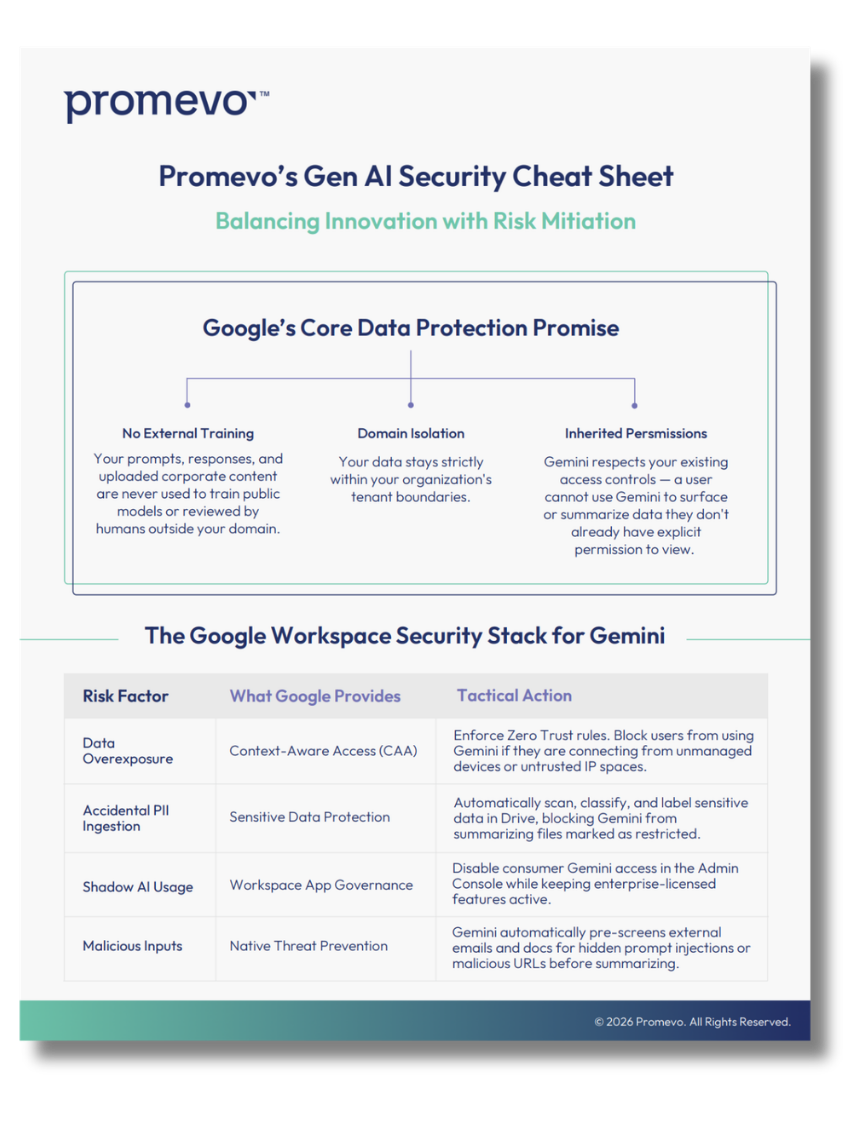
A central concern when deploying consumer-grade chat applications or third-party APIs is data privacy. With Gemini Enterprise and Gemini for Workspace, your enterprise data is never used to train public models outside your domain. Data inputs and outputs remain completely isolated within your organization's Google Cloud perimeter, ensuring compliance with strict governance frameworks.
Strategic Advantages for Google-Centric IT Environments
Selecting the right AI platform involves more than simply evaluating model benchmarks; it requires assessing how seamlessly that platform integrates into your broader operational ecosystem. For organizations already invested in Google Workspace and Google Cloud, building on Gemini delivers distinct structural advantages over maintaining disconnected third-party platforms.
Centralized Governance & Identity Control
Deploying standalone AI platforms often creates shadow IT risks, data fragmentation, and unmonitored security endpoints. Integrating Gemini within your established Google Cloud and Workspace environment unifies security administration. IT teams can enforce unified access policies, maintain strict identity controls, and apply consistent data governance standards across all AI interactions using the administrative tools they already manage.
Reduced Operational Complexity
Adding disparate AI point solutions increases administrative friction, requiring separate billing management, isolated security reviews, and vendor-specific access provisioning. Leveraging Google’s native AI ecosystem eliminates these operational hurdles. Unified procurement, centralized billing, and cohesive management interfaces simplify administrative oversight, allowing IT directors to focus on driving technology adoption rather than managing redundant operational overhead.
Accelerated Adoption Across Everyday Workflows
Technology investments only deliver business value when employees actively adopt them. Because Gemini capabilities are embedded directly into Google Workspace applications (Gmail, Docs, Drive, Meet), custom AppSheet apps, and standalone web interfaces (gemini.google.com), enterprise users can access AI support within their existing daily tools. This native availability removes friction, accelerates organizational adoption, and turns generative AI into a practical tool that drives measurable productivity gains.
Building an Intentional AI Architecture with Promevo
The organizations achieving the highest ROI from generative AI are not searching for a single model to solve every task. They are building intentional, multi-tiered AI architectures. High-frequency automated customer interactions run efficiently on Gemini 3.5 Flash-Lite or 3.6 Flash, analytical research teams leverage Gemini 3.1 Pro, and specialized engineering challenges route directly to Gemini 3.6 Thinking.
At Promevo, we believe the ideal AI solution is the one that delivers the optimal balance of speed, intelligence, and cost efficiency for your specific operational goals. As a Premier Google Partner, we help IT and data leaders evaluate workloads, design governed cloud architectures, and maximize value across the Google ecosystem.
The right partner ensures you aren't carrying the burden of platform shifts, security controls, and change management alone. Promevo works alongside your team to turn complex Google AI capabilities into scalable, well-governed business results.
Ready to move from AI experimentation to a scalable enterprise architecture? Reach out to Promevo’s Google AI experts today to learn how our Gemini Enterprise Accelerator can help your organization build, deploy, and adopt AI with complete confidence.