

Most organizations are not single-platform environments. You may rely on Microsoft 365 for email, file storage, and collaboration while evaluating advanced AI platforms to accelerate research, automation, and content creation.
That’s where Gemini Enterprise with Microsoft 365 becomes relevant.
Gemini Enterprise isn’t limited to Google Workspace environments. You can deploy it alongside Microsoft 365 and extend AI capabilities across your existing systems without migrating mailboxes or moving files into Google.
For leaders evaluating AI strategy, this opens a broader set of options.
The Agnostic AI Advantage
Gemini Enterprise functions as a standalone, agentic AI platform. It is not restricted to Google-native productivity apps, and it is not a mirror of Microsoft Copilot.
You can deploy Gemini Enterprise using:
- Cloud Identity
- A Google Workspace Business Base license
Your organization doesn’t need to shift email or file storage to Google to benefit from Google’s large language models. This flexibility matters for Microsoft-centric environments that want access to:
- Advanced creative reasoning
- Multimodal generation across text, image, and video
- Extremely large context windows for long-form analysis
High-fidelity image and media generation tools
Gemini Enterprise gives Microsoft 365 organizations access to Google’s AI innovation layer while preserving existing infrastructure decisions.
Gemini Enterprise as a Technical Bridge
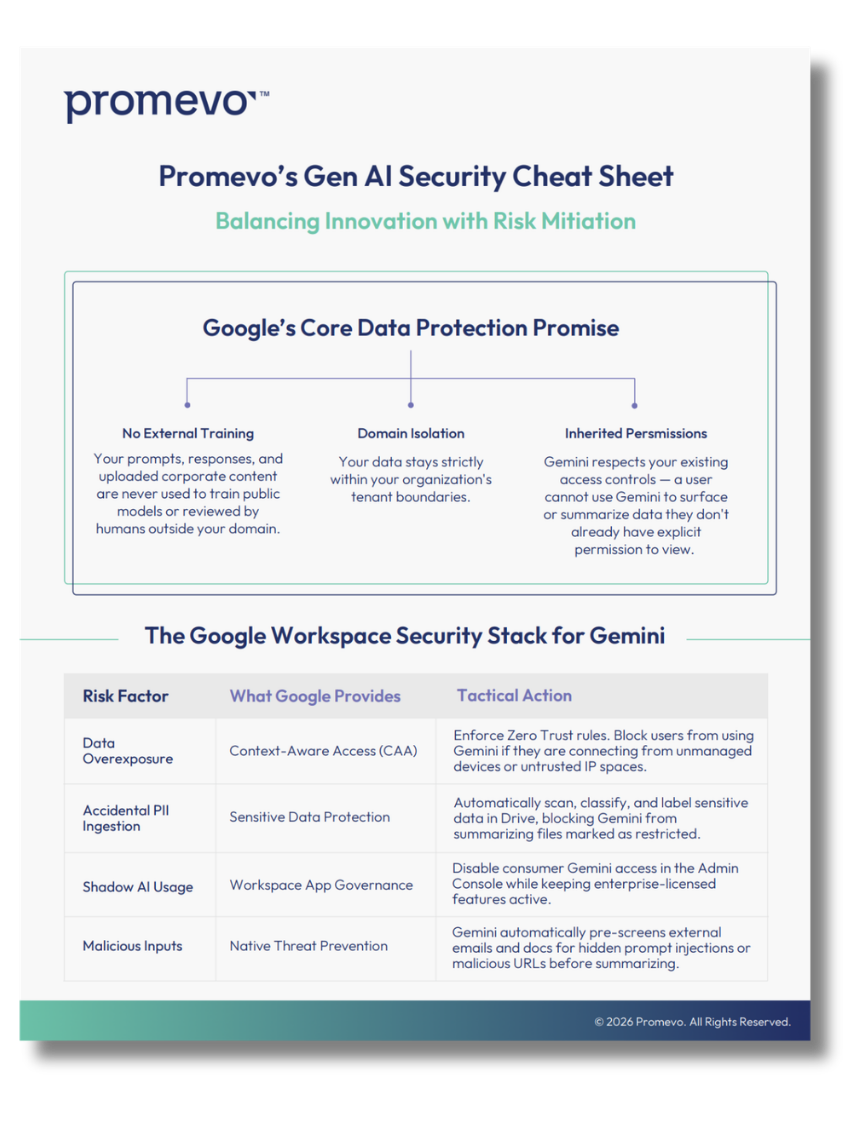
AI value depends on secure, accurate access to your data. Gemini Enterprise integrates with Microsoft environments in ways that respect existing controls.
Permissions Parity with Microsoft Entra ID
Gemini Enterprise integrates with Microsoft Entra ID (formerly Azure AD) to honor existing identity and access controls.
If a user doesn’t have permission to view a SharePoint file, then Gemini can’t access that file on their behalf. AI responses reflect the same security boundaries already enforced in your environment.
This alignment reduces risk while enabling cross-platform intelligence.
Federation vs. Ingestion
When connecting Microsoft 365 data to Gemini Enterprise, organizations can choose between different access models.
Data federation provides live, just-in-time access to systems like Outlook and OneDrive. Gemini queries data directly without storing it long term.
Ingestion, on the other hand, synchronizes selected data into structured data stores to support deeper research, pattern analysis, and more complex queries.
The right approach depends on latency requirements, security policies, and use case complexity. Promevo helps you evaluate which model fits your governance framework.
Enterprise Security Standards
Gemini Enterprise runs within Google Cloud’s enterprise-grade infrastructure, so users benefit from:
- SOC 2 alignment
- HIPAA support where applicable
- Clear data isolation policies
- Administrative visibility and control
- Protections ensuring customer data is not used to train global foundation models
For leadership teams, this clarity supports risk management conversations early in the AI evaluation process.
Pre-Built Connectors for Microsoft 365
Gemini Enterprise includes pre-built connectors that integrate directly with Microsoft applications.
SharePoint & OneDrive
Gemini can analyze large volumes of legacy files stored in SharePoint or OneDrive.
Use cases include:
- Searching thousands of Excel files for specific financial metrics
- Extracting key clauses from archived PowerPoint decks
- Summarizing historical project documentation
- Identifying inconsistencies across distributed documents
Instead of manually reviewing content, teams can query structured insights from existing repositories.
Outlook (Email & Calendar)
Gemini integrates with Outlook to:
- Summarize long email threads
- Draft responses grounded in conversation history
- Reference calendar availability when composing follow-ups
- Extract commitments and action items
AI assistance extends directly into existing communication patterns.
Microsoft Teams
Gemini can ground responses in Teams chat history, helping bridge context across ongoing conversations. For distributed teams, this supports continuity across channels without switching platforms.
Expanding Beyond Microsoft: A Connected AI Layer
While Copilot primarily focuses on Office-native workflows, Gemini Enterprise connects across a broader enterprise ecosystem.
- Salesforce and HubSpot for CRM workflows
- Jira and Confluence for project management
- BigQuery for advanced analytics
- Box and Dropbox for external storage
This cross-platform connectivity shifts AI from a document assistant to a system-level intelligence layer.
The Agentic Shift & Model Context Protocol
Gemini Enterprise supports the Model Context Protocol (MCP), which enables AI agents to communicate across systems using standardized context exchange.
In practical terms, this allows Gemini to:
- Pull structured data from CRM systems
- Reference documentation from SharePoint
- Access project updates from Jira
- Draft communications in Outlook
AI becomes an orchestrator across tools rather than a feature confined to a single suite.
For organizations operating in mixed environments, that interoperability drives meaningful differentiation.
High-Impact Use Cases for Microsoft 365 Environments
Cross-silo work often creates friction. Gemini Enterprise reduces that friction by connecting systems. Let’s look at a few real-world examples.
Cross-System Research
A team member can:
- Summarize a proposal stored in SharePoint
- Cross-reference associated revenue data in Salesforce
- Draft a follow-up email in Outlook
- Validate timeline details against project plans in Jira
This workflow happens within one AI interface grounded in secure access controls.
Multimodal Content Creation
Marketing or communications teams can:
- Convert a Word-based technical whitepaper into a concise executive summary
- Generate visual assets based on structured text
- Produce short-form video explainers
- Adapt long-form documentation into campaign-ready materials
Gemini’s multimodal capabilities extend creative output beyond text.
Agent-Driven Workflows
Organizations can design AI agents that:
- Monitor support emails in Outlook
- Pull resolution guidance from Zendesk or ServiceNow
- Draft structured responses
- Flag escalation risks automatically
This reduces response time while maintaining governance.
Why Partner with Promevo
Deploying Gemini Enterprise in a Microsoft 365 environment requires careful identity mapping and permission alignment.
Promevo supports:
- Identity integration between Google and Microsoft systems
- Secure connector configuration
- Governance planning
- AI pilot workshops
- Change management and adoption strategy
Our Gemini Enterprise Workshops help your team validate use cases, align stakeholders, and define measurable outcomes before full-scale rollout.
AI adoption requires more than activation. It requires structure.
A Broader AI Strategy for Microsoft 365 Organizations
Microsoft 365 environments no longer need to choose between ecosystems.
Gemini Enterprise with Microsoft 365 allows you to:
- Maintain existing infrastructure investments
- Extend AI capabilities across systems
- Protect enterprise security standards
- Connect data across silos
- Accelerate research, automation, and content generation
For leadership teams evaluating AI direction, this model supports flexibility without compromise.
If your organization runs on Microsoft but seeks broader AI capability, Gemini Enterprise provides a secure, interoperable path forward.